A Lot More to Do – Fairer Communities
Your Labour council has invested in making Westminster safer and more inclusive over the last four years, backing our community groups and opening up cultural opportunities. We will support our outstanding children’s services and schools, while doing more to protect older people and help them with cost-of-living pressures.
Public protection and licensing
The previous Conservative administration let the council’s CCTV network become obsolete and then they scrapped it in 2017. Under Labour we now have a modern network of more than 200 cameras as of late March 2026 at crime and anti-social behaviour hotspots, enabling live arrests and evidence gathering, and providing reassurance to local residents. We funded an 18-strong Police and Council Tasking team (PACT) that focuses on tackling crime and anti-social behaviour that most affects our residents, combining 9 Met police officers that are working alongside 9 ASB specialist City Inspectors to make arrests, enforce legislation and increase visible patrols. We have also created a new Street Based Intervention Team of City Inspectors and homelessness outreach officers to help tackle ASB linked to issues on our streets. We have introduced new Public Space protection Orders (PSPOs) on anti-social behaviour. If we are re-elected we will:
- Install a further 150 cameras to the public realm network to reach 350 by 2028.
- Introduce new AI monitoring tools to enable CCTV footage to be retrieved and analysed more quickly.
- Reform and upgrade the Housing CCTV network to make it more effective in keeping our tenants and leaseholders safe.
- Work with partner organisations in the West End and across the city to see how our technology and our control centre partnership with Hammersmith and Fulham can assist in improving outcomes.
- Enforce our new Public Spaces Protection Orders (PSPOs) and enable the police to be able to use them more effectively.
- Target the 18-strong Police and Council Tasking team (PACT) on areas of crime and ASB that affect residents the most.
- Recruit more city inspectors and provide greater capacity at evenings and weekends where residents need extra support.
- Expand the Street Based Intervention Team (SBIT), which combines City Inspectors with Homelessness outreach workers, with more officers so it can cover more areas.
- Implement the Late Night Levy by 2028 as set out in Westminster After Dark, with the proceeds of the levy invested in improving safety in areas of the city with a significant nighttime economy.
- Deliver our Westminster After Dark safety commitments, including better lighting and CCTV coverage in high footfall areas such as in the West End.
- Introduce our new licensing policy and Cumulative Impact Assessment to ensure the council’s licensing function is operating on up-to-date information and policies.
- Use the findings of the Soho Monitoring study (which covered noise, air quality and traffic) to inform the development of council policies and public realm mitigations to manage the impact of the commercial and nighttime economy on local residents.
- Defend the importance of a strong Westminster licensing service that retains the power to manage the night-time economy in Westminster in a cohesive and balanced way. We will lobby to ensure any new Mayoral role focuses on genuinely strategic issues rather than try to second-guess local licensing committees.
Backing our Voluntary Sector
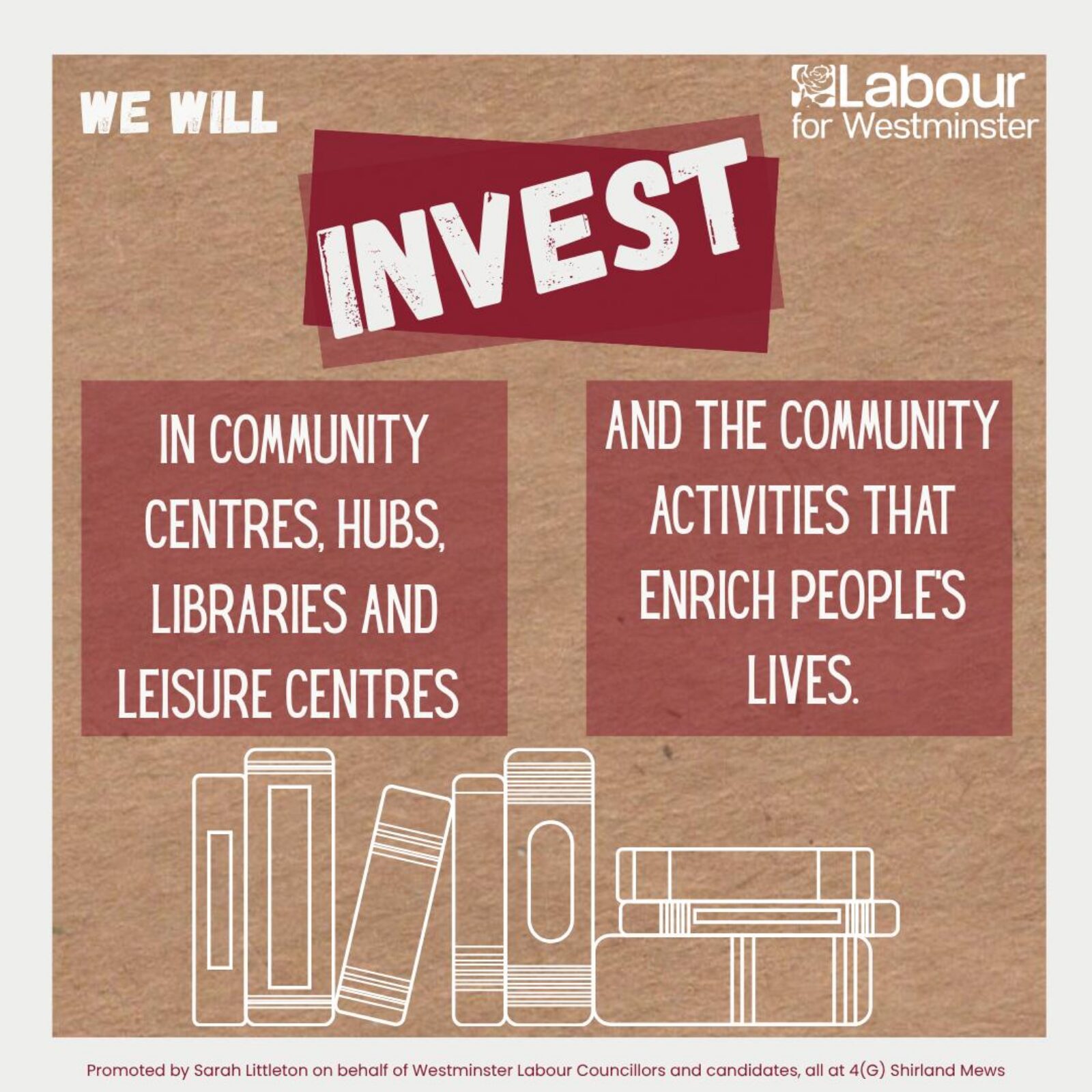
For decades under the Conservatives the local voluntary sector was undervalued and underfunded, despite the great work our community organisations do to transform people’s lives. The Conservatives ended all council funding for youth clubs and limited their investment to little more than councillor ward budgets and funding from the public health grant. Labour has changed that by introducing new grant funding programmes for voluntary and community sector organisations, and opening six community hubs which provide more space for community activities and help for local people. If we are re-elected we will:
- Continue to fund the voluntary sector with both long-term and project-based money, paying for activities, services, capacity building and capital projects, whilst continuing to strengthen our outcomes monitoring to ensure this investment makes the maximum impact.
- Retain and strengthen our Community Hubs at Lilestone Street, Charing Cross, Victoria, The Exchange, The Brunel and Rampayne Street, unlocking their full potential as places for advice, employment support, health services and community activity.
- Introduce more face‑to‑face access points for services and support, through the community hubs, new housing offices and our Community Action Team.
- Back local organisations to take on the management of local community centres, bringing stability and local benefits. We will invest in upgrading these spaces and provide management support where needed to ensure long‑term sustainability.
- Co-produce a ‘compact’ to establish the principles of how the council and the voluntary sector should work together to meet our Fairer Westminster ambitions.
- Unlock underused council buildings for community use where appropriate, for example bringing back into community use the former Paddington Green Estate Office.
- Strengthen partnerships with the council’s Responsible Business Network to bring additional support into local communities.
Equalities, Faith and Inclusion
Westminster is home to some of the most diverse communities in the country, with people from around the world choosing to make their home here and a longstanding LGBTQ+ community. Westminster is home to people of all faiths and none. Every community should feel safe, respected and welcome. Under Labour, Westminster Council will continue to stand up against the deeply worrying rise in far-right activity, racism, islamophobia, antisemitism, anti-migrant language, and hate incidents that impact our communities here in Westminster. We will:
- Monitor complaints about council services to see if there are any themes of discrimination or under-provision against any particular groups and work to ensure that there is equity in how council services are provided.
- Support activities and events that celebrate the diversity of our borough and promote community cohesion, building on our community equality strategy published in 2025.
- Improve council services for everyone to make sure services are accessible and appropriate for people of all protected characteristics as well as care leavers and people affected by poverty and low income.
- Deliver on the commitments made in our ‘A Westminster Welcome’ borough of sanctuary strategy to improve the council’s treatment of asylum seekers and refugees while they are staying in our city and stand up to protect the diverse communities that live in Westminster.
- Ensure all faith communities feel valued in our city, recognising that contribution through the Westminster Faith Exchange that promotes interfaith dialogue and community cohesion.
- Enhance the council’s security support to places of worship and community venues.
- Help faith and community groups access suitable gathering spaces, including making appropriate use of underused council buildings.
- Stand firmly against the rising tide of hate crime, racism and discrimination in all its forms that seems to be proliferating at present. We unequivocally condemn racism, xenophobia, Islamophobia, antisemitism, and far-right extremism, and continue to work with the police and community partners to ensure related crimes are tackled swiftly and victims are treated with dignity and respect.
- Champion and support our LGBTQ+ communities, ensuring they feel safe, visible and valued in Westminster, and standing firmly against discrimination in all its forms.
Adult Social Care
We are committed to providing the highest-quality services to residents who are frail, disabled or have mental health needs, and to working with other council services to ensure a holistic approach. We know that the cost of living is putting particular pressure on these residents and we think it’s important that they are able to keep more of their own money when they need help with their care. We will:
- Raise the income threshold of when residents pay for home care to over £300 per week, to ensure 75% of homecare service users don’t pay for their care. We have already increased the income threshold to £272.69 per week for all service users, which means 65% (up from 49% when we took power in 2022) of our home care service users currently don’t pay for their care.
- Increase general needs social housing ringfenced for residents with significant disabilities to ensure that more disabled people can stay in the borough and live independently where appropriate. We have already increased the availability of general needs social housing so that 10 direct offers are made per year, and we will double this to 20.
- Build the additional specialist housing we need, with 24 homes for specialist accommodation for adults with significant care needs in the new development on 291 Harrow Road, the conversion of the Lodge in Paddington Rec into housing for two people with complex needs, and more to come in the housing pipeline.
- Open new 5 mental health beds to support rough sleepers experiencing mental health crises and new 5 mental health beds for mental health patients who are ready to step down from hospital care to supported accommodation in partnership with the NHS.
- Fulfill the highest level of commitments under the Ethical Care Charter which we signed in 2022 and continue to ensure that our commitment of paying staff £1.50 an hour over the London Living Wage applies in every homecare contract to compensate staff for time spent travelling between appointments.
- Improve the transition from children’s services to adults’ services, working with families to ensure it is as smooth as possible for young people and their carers.
- Commit to ensuring that adults with Learning Disabilities have meaningful opportunities in education and employment and have access to enriching activities. We will work with service users, families and carers as well as service providers, voluntary sector organisations and employers, and we will commit funds to ensure that this is the case.
- Enhance services for children and young people with substance misuse needs and work with schools to provide services that promote good mental and physical health.
- Ensure there is no waiting list for adult social care assessment, while continuing to deliver high quality public health and adult social care services.
- Make progress on reducing the gap in life expectancy between the poorest and wealthiest areas of the borough. This aim is built in all the areas of the council through the #2035 programme, working with partners in the VCS and the NHS to achieve this.
- Take action to protect residents’ health and wellbeing from stressors including air pollution, noise and factors that contribute towards obesity.We will work with departments across the council, to ensure our policies and the approach to public spaces are guided by these Public Health principles, maximising factors that contribute positively to residents’ health, like green spaces and opportunities for physical activity.
- Ensure the voices of our Adult Social Care users and their carers are heard through the co-production of relevant policies and processes.
Help for older people
- Sign up to the Age-Friendly Communities Framework. We will ensure that different council departments – Adult Social Care, Highways, Place Shaping, Housing, Economy, Communities, and Communications – work together to make sure that our city is as accessible as possible to older people and disabled people.
- Engage with older people’s forums and disabled people’s forums so that our residents can lead and monitor the progress.
- Protect and enhance the successful Winter in the City programme that provides support to older and vulnerable people during the winter months.
Building an accessible and inclusive Westminster
Disabled people will be at the heart of how we design our city, our services and our communities. We will make Westminster a city where accessibility is the norm, not an afterthought, and where disabled residents shape the decisions that affect their lives. We will:
- Designate a Lead Executive Director for disability inclusion, to take overall responsibility across the council, ensuring clear leadership and accountability.
- Ensure disabled access and rights will be written into the fabric of Westminster Council, shaping how we design services, buildings and public spaces, as well as how we upgrade existing venues.
- Strengthen disability awareness training for all staff operating on the frontline (including recognition of the sunflower lanyard) and improve everyday interactions for disabled residents.
- Co-produce best practice guidance for cultural venues to accommodate those living with dementia, autism and other health-related conditions.
Everyday sport and play
Health and physical activity should not depend on income, background or postcode. Yet some residents face barriers of cost, inaccessible facilities, lack of inclusive equipment or simply not knowing what is available. We are determined to break those barriers down while improving leisure services and play spaces for everyone. We will:
- Ensure every child has access to high‑quality, safe play space within walking distance of their home. By 2030, at least 14 playgrounds across Westminster will be upgraded – the most ambitious renewal programme in a generation. Upgrades will take place at Golden Square, Pimlico Gardens, Lupus Street, Avenue Gardens, Causton Street, Chippendale, Drury Lane, Fisherton Street, Lisson Green (Under 5s), Mozart-Lawes, Orange Park, Paddington Street Gardens, Porchester Square, Westbourne Green Open Space and Hallfield Estate.
- Deliver a large new inclusive destination playground at St Mary’s Churchyard, Paddington Green.
- Improve playgrounds on housing estates so children growing up in council homes have safe, high‑quality facilities close to home.
- Improve accessibility for children with disabilities and SEND so inclusion is designed in from the start. Our new playground strategy sets out how we will put accessible equipment in every playground.
- Increase access to nature‑based play, recognising the importance of green space, outdoor learning and contact with nature for children’s mental and physical health.
- Unlock open space designed by the community through redevelopment at Sussex Street.
- Deliver at least five permanent, all‑weather Multi‑Use Games Areas (MUGAs) in key parts of the city, giving residents reliable places to be active whatever the weather. These will include:
- Upgrading existing MUGAs at Drury Lane, Church Street (Kennett House) and two at Queen’s Park Gardens.
- Delivering new MUGAs at Ark King Solomon Academy (Younger Years) and Wilberforce.
- Replacing the current Elmfield Way MUGA with a new enclosed games area as part of the redevelopment of 291 Harrow Road.
- Broaden the sporting offer at our MUGAs and increase participation, with a particular focus on girls and under‑represented groups.
- Improve Paddington Recreation Ground by introducing padel, diversifying the sporting offer and refurbishing the gym facilities.
Inclusive, Affordable Leisure Centres
Our leisure centres should feel welcoming, modern and accessible to all. We will work to ensure that cost is never a barrier to good health. We will:
- Keep prices affordable and protect resident discounts.
- Protect free swimming for Westminster families during school holidays, introduced by Labour and at risk if the Conservatives regain control.
- Maintain free swimming for over‑60s.
- Upgrade more gym equipment to ensure genuine inclusivity, including accessible equipment for wheelchair users, older residents and people living with long‑term health conditions.
- Improve accessible and women’s changing facilities so everyone feels comfortable and respected.
- Increase the number of inclusive sessions, including women‑only and disability‑inclusive activities.
- Maintain fair access policies so residents, schools and community groups are prioritised.
- Open the remodelled Seymour Leisure Centre in early 2027.
- Protect and future‑proof the Queen Mother Sports Centre. We are examining redevelopment options to upgrade the facilities and provide opportunities for new housing. If the project proceeds, swimming will remain a priority, while we explore viable phased improvements and appropriate development that enhances public facilities, supports housing delivery and minimises disruption through meaningful community engagement.
Supporting Westminster’s Children and Young People to thrive
We continue to prioritise high standards in child protection, early help and family support. Westminster’s children’s services have been rated outstanding by OFSTED, one of very few councils nationally, reflecting strong performance in supporting vulnerable children and families. We will continue our partnership work with local schools to help raise standards and improve support for children with SEND.
We will:
- Ensure our children’s services remain outstanding.
- Continue cost of living support for families by continuing the council’s Cost of Living Fund and working with the Government’s new Crisis and Resilience Fund.
- Protect free school meals for Westminster children in local schools from ages 3-14.
- Expand College Park special school at a new site, the former George Elliot Primary site in St John’s Wood, where we will be creating new SEND secondary school places. Invest in youth services and opportunities. Our delivery plans for the next four years include continued support for youth services, funded activities, play provision (including for children with SEND) and community projects that help young people thrive.
- Strengthen engagement with families of children with SEND and the organisations that support them like ‘Make it Happen’. We will continue the grant funding that enables organisations to support children with SEND.
- Enhance our support for care leavers with paid placements, coaching and well being support, helping them transition to independence and employment with extra funding from the National Youth Trailblazer program.
- Build a brand new Family Hub in Queen’s Park and strengthen our family hubs across the city.
Culture open to all
While the Conservatives were often just happy to celebrate Westminster already containing top-class cultural institutions, Labour has actively worked with leading theatres and arts organisations to ensure they are as accessible and inclusive as possible for all our residents. Labour understands the educational, wellbeing, health, and economic benefits that access to the arts can bring. If elected we will:
- Ensure all children in Westminster attend the theatre before they leave school, as part of the pioneering Theatre for Every Child campaign.
- Improve and grow ArtsLink Westminster, to reach over 100 institutions and more schools.
- Enhance our Culture Commissioning Grants grant programme, to ensure all groups in Westminster can benefit from our creative industries.
- Develop a Cultural Workforce Development Plan to support young people and residents to enter creative and cultural careers.
- Create new free or low cost activities in partnership with cultural and community organisations.
- Implement the Cultural Inclusion Manifesto, working with local cultural institutions to develop best practice guidelines on improving access and inclusion.
- Develop a seasonal calendar of all grass-roots celebrations and community activities, with a focus on more free resident events and showcasing faith, ethnic and marginalised group celebrations.
- Empower community providers to co-produce creative health activities for vulnerable resident groups, by signposting free or low-cost spaces and resources.
- Provide new affordable and supportive creative workspaces through the Enterprise Space Programme and meanwhile uses, while continuing the North Paddington Creative Enterprise Zone.
- Map cultural assets and infrastructure for local areas to identify recommendations for culture at an early stage during new planning developments.
- Place public art and cultural activities at the heart of place activation strategies all across the City.
Libraries and public toilets
Labour has protected these vital community assets, improving our libraries and making the largest investment of any council in the country to upgrade our public toilets. We will continue this commitment and if re-elected we will:
- Protect all of our existing library provision across the borough in recognition of the importance they play for our communities.
- Open a second Library of Things to enable people to share items and skills and avoid one-time purchases, building on the initial scheme in Pimlico. We are scoping out a site in Paddington and will explore further sites across the city where possible.
- Make our libraries accessible to all. We are identifying actions and funding to make all our libraries accessible to all, with new work at Mayfair library to deliver a lift and new ambulant toilet.
- Grow our Libraries and Archives’ community role as inclusive cultural centres and as a connector for creative health programmes.
- Examine opportunities to install more publicly accessible toilets in different areas of the borough
- Introduce Westminster’s first community toilet scheme focused on areas currently lacking provision to ensure residents and visitors have a complete, clearly mapped network of toilets across Westminster. These would include participating leisure centres and local organisations. We intend the public toilet map to be made available and publicised.